Looking Over the Cubicle Wall at Days Gone By

My favorite picture of my daughter when she was little,
surrounded by memories of places visited or projects
created at our dining room table. The crocheted butterfly
was made by my own mother over 25 years ago.

I cry about three times a year. I don’t cry when I’m sad or angry, and my tears always catch me by surprise. What’s worse, they are often embarrassing, because they pop out in public.

When I worked at the Wisconsin Department of Agriculture, I would break out into tears at my desk about every six months, mostly from the sheer frustration of trying to work in a government bureaucracy that did not move as fast as I wanted. On those days, Dr. Myron, the state fish veterinarian, who sat in the adjacent cubicle, would slowly stand up, gently peak over our cubicle wall, and gently ask if I was alright. I would always answer with an emphatic yes, and that I would be fine in a few minutes. And I always was. Whenever I cry to this day, I think of that tall, kind man, asking if I was going to be okay.

Today was the first time I cried in a long time, and it happened in of all places, the Sunday church service. There’s nothing like breaking out in tears in a room of 150 people, many of whom have become like family over the years, but many of which are still strangers, and where in both cases,  men have no idea what to do, and frantically elbow their wives to do something.

Today was Children’s Sunday, where the kids in our Sunday School presented all the things they had been learning the past few weeks about discipleship. As I watched a three-year-old girl dressed up in a fancy dress not follow her script and instead interrupt the pastor with a very detailed story about what characters were her favorite in a game she played at home, I looked to the parents, sitting in the audience, who were wearing looks of utter mortification. I’m sure they believed their child was ruining the children’s sermon. What I wanted to do, was to stand up over the cubicle wall, and tell them it was going to be alright: that this was a moment they would remember forever, and that every adult in the audience was either 1) remembering with fondness their children at that same age, 2) thanking God it wasn’t their kid talking, if they had kids that same age, or 3) wishing it was their child because they either had lost a child or perhaps couldn’t have children.

And that is when I inexplicably broke out into tears. Because my little girl is now 18, has moved out of our house, and is happily living her own life. But when she was three years old, she sat on steps just like the ones today, wearing a fancy dress, and in the very middle of the Children’s Sermon, stood up, lifted up her skirt, and announced as loud as humanly possible: “I forgot to wear underwear today.” I remember frantically motioning to her from the audience to sit down, and still remember the feeling of being utterly mortified, wishing God would at that moment just swallow me up whole. I believe the situation was rendered by the pastor hastily saying: “Let’s pray,” and all the kids following his lead of sitting down and putting their hands together.

That moment has become a storytelling staple in our house, and it is always told with laughter and fondness. And while I remember that moment vividly, it seems the years that led to that point, and the years after that day, are a blur. As a parent, we are always too busy. Busy with work. Busy with school. Busy with stuff. Stuff. And we very rarely take the chance to sit down and think: this day is never going to roll around again. And pretty soon those days turn into months and the months turn into years, and in a flash, your little girl with the fancy dress is all grown up and gone.

While parents of grown children are always happy for our kids to go out into the world to do their own good work, it is often not until they are gone, that one sits on the sofa and realizes how quiet the house is. And sometimes one wishes they could have just a day or two back of having a little girl, especially one, who one Sunday long ago, interrupted a children’s sermon with a story of her own.

Wisconsin Cheese Mart to offer 28-Year Old Cheddar

Twenty pounds of 28-year-old Cheddar – presumed to be the oldest commercial Cheddar ever verified and offered for sale in America — will hit the market on Oct. 6 at an official Block Cutting Party at the Wisconsin Cheese Mart in Milwaukee.

The 28-year-old Cheddar will be priced at $6 per ounce – yes, ounce – and will only be sold at the store’s Cheese Bar. Additional super-aged Cheddars, at 20-plus years old, will be offered for sale in one-half pound wedges at the Cheese Mart shop for $60 per pound.

Wisconsin Cheese Mart owner Ken McNulty says all of the aged Cheddars are in excellent shape, and feature substantial crystallization on the outside of each block. The cheeses are sourced from two different Wisconsin cheese factories. Each block features an exact date of production and letter of verification from the cheesemaker.

“We are extremely lucky to have found these blocks of Wisconsin Cheddar and look forward to sharing them with the public for the first time on October 6th,” McNulty said.

The 28-year-old Cheddar is crafted by Ed Zahn, long-time cheesemaker at County Line Cheese in Oconto. A back injury in 1989 forced him to retire from cheesemaking, so Zahn decided to run a retail cheese shop instead. This spring, Zahn decided to retire for good. While sorting through the store’s inventory, he found a big surprise: many blocks of cheddar that were more than 20 years old. Zahn had made this cheddar at County Line in between 1984 and 1988.

“During the process of transferring cheese from the factory into another walk-in cooler, some of the blocks were misplaced in the walk-in cooler,” Zahn said. In a letter that will be included with every purchase of the 28-year-old Cheddar, Zahn says: “I take pride in the cheese that I made at the County Line Cheese factory from 1960 to 1988. Despite the fact that County Line is now closed, you can still enjoy my superb cheddars.”

In addition to the 28-year-old Cheddar, Wisconsin Cheese Mart will also offer a series of 20-plus-old Cheddars, some also produced by Zahn, and others crafted by cheesemaker Wayne Hintz, owner of Springside Cheese in Oconto Falls since 1973. Well-known for its award-winning Bandaged Cheddar and White Cheddar, Springside Cheese is one of northeast Wisconsin’s longest-running factories.

In a signed letter to be included with each 20+ Aged Cheddar, Hintz writes: “The cheese you purchased today is not only rich in flavor, it is also rich in tradition and history. Hand-made more than 20 years ago, it is one of the most aged cheeses in the world. I hope you enjoy its taste as much as I enjoyed crafting it.”

All Aged Cheddars will be available beginning at 11 a.m. on Oct. 6th at the Wisconsin Cheese Mart and its adjoining Cheese Bar, at 1048 N. Old World 3rd Street. in Milwaukee. For more information, visit www.wisconsincheesemart.com/cheese-bar/28-year-cheddar/

On Location: Roquefort Caves

Day 7 of the Grand Cheese Tour of France: the Roquefort Caves. Oh yeah, baby.

Visiting the caves where the king of cheese is aged was on the bucket lists of quite a few people on this tour. Driving from our hotel in Montpellier to the tiny village of Roquefort was a journey unto itself. A steep ascent up a series of mountain tunnels, picturesque countryside, 17th Century villages and terraces of grape vines and olive trees brought us to the tiny village of Roquefort-sur-Soulzon.

A series of ancient landslides in this “Combalou” plateau generated the unique site of Roquefort, creating the famous first ripening caves, which of course have been enlarged and enhanced by people in the centuries since.

The Combalou plateau region is home to seven Roquefort producers, but the largest is Roquefort Société, made by the Société des Caves de Roquefort, which owns several caves and opens its facilities to tourists like us. These folks have invested a serious amount of time and money into giving visitors a unique educational experience with several “wow” factors, such as showing us a brief film in French on the sides of the original caves describing the traditional legend of how Roquefort came into being.

Legend has it that the cheese was discovered when a youth, eating his lunch of bread and ewes’ milk cheese, saw a beautiful maiden in the distance. Abandoning his meal in a nearby cave, he ran to meet her. When he returned a few months later, the mold (Penicillium roqueforti) had transformed his plain cheese into Roquefort. Who knows if it’s true or not, but it sure gives a romantic start to one of the world’s most famous cheeses.

Because it’s September, and the region’s Lacaune ewes are not producing milk, the caves were not filled with wheels of Roquefort. We knew this going in and expected it to be a huge disappointment. It was not. As it’s open year round, and the caves are only filled six months of the year, Societe fills the caves with thousands of life-like wheels of cheese to give visitors a sense of how the cave looks when it is full. (You’ll notice I don’t have any photos inside the caves – pictures are not permitted, and we snapped this one just as we were starting our tour, walking through passageways to reach the caves.

In its series of three caves, each with a different natural temperature and natural humidity that can range by up to 10 degrees, (the air in each is naturally renewed by fleurines, or natural faults in the earth), Society produces three types of Roquefort:

Societe L’Excellence: probably the best known Roquefort in America, this cheese is exported to more than 100 countries around the world.

Societe Caves Baragnaudes la Delicatesse: this cheese is often exported to American in time for Christmas shopping. A creamier, milder blue, it boasts a pleasant lingering flavor. Our guide encouraged us to taste it with a bit of gingerbread, which was an excellent pairing.

Cave de Templars: accounting for only 2 percent of the company’s production, this little-known Roquefort is distributed locally, which alone might make it worthwhile to move to the South of France. It is incredibly strong and tangy and lingers in your mouth far longer than its better known sisters. It was amazing to try this cheese after the tour, as most of us never even knew it existed.

Our guide did a superb job in demonstrating how Roquefort is produced and aged. Roquefort starts with unpasteurized, full fat milk from the region’s Lacaune ewes, collected from farms in a 90-mile radius of the village, six months of the year. The milk is taken to neighboring dairies, where it undergoes an 8-day make process. While there are more than 200 strains of Penicillium roqueforti, Societe uses just three different ones to produce its three different Roquefort cheeses.

The cheese is then transported to the caves and pierced once with 40 needles. A work force of 30 people – 15 men and 15 women work in the caves. The men place the wheels by hand on salted wooden shelves, where the cheese sits, untouched and unturned, for a period of 14 to 25 days. During this time, the Penicillium roqueforti rapidly develops inside, while the salt melts and is diffused, lending to the the cheese’s creamy interior.

At some point between the 14th and 25th day, the cellar master determines when each wheel is ready to take the next step. It is then wrapped by one of 15 women, who have been hand-wrapping Roquefort wheels for generations. Each wheel is wrapped in a sheet of tin, which is very malleable, but strong. Each lady wraps 750 wheels a day during the aging months. To give you an idea of how big these caves are, we saw three different levels, and one level alone held 23,000 wheels. Wowza.

After the wheel is wrapped in shiny silver tin, it goes to the man-made cold rooms, kept perfectly at 32 degrees F, where it completes its aging process slowly. It is this deep-cold aging process that allows Roquefort to be distributed throughout the year, with masters taking each wheel out when it reaches perfect maturation. The tin is then removed, the wheels are cleaned, wrapped in foil or cut and placed into special plastic containers, and sent to market. The cheese must be packaged in the village to retain its special Roquefort AOC status.

An amazing process and experience to witness, the Caves of Roquefort do not disappoint. I have the feeling I’ll be smiling every time time I request Roquefort on my salad at a restaurant in the States, remembering the craftmanship that went into the cheese and the beautiful region responsible for its creation.

Hidden Springs Creamery Says: Name that Cheese!

If you ever wanted to help create and name a cheese, this is your chance.

Cheesemaker Brenda Jensen, owner of Hidden Springs Creamery, a farmstead sheep dairy near Westby, is looking to create a new flavor of her Driftless cheese, a perennial award-winner. Deliciously simple, consisting of just sheep’s milk, culture, rennet and salt, this wonderfully light, creamy and spreadable cheese is fluffy, lemony and finishes with just a hint of the wonderful grasses which sustain the farm’s flock. Think of it as a sheep’s milk chevre.

Currently available in an ever-evolving blend of flavors, including Basil & Olive Oil, Cranberry & Cinnamon, Tomato & Garlic, Pumpkin, Maple and Honey & Lavender,  Brenda is now looking to develop a new flavor. She’s excited about partnering with Wisconsin Cheese Originals members and blog readers on suggestions.

Want to participate? Email me your suggestions for a new flavor and include your name and address so we can give you credit. Brenda will select the suggestions she likes, and then attendees at the Third Annual Wisconsin Original Cheese Festival’s Meet the Cheesemaker Gala on will vote for the winner (tickets to the gala go on sale next week: click here for a preview of festival events).

Here are the guidelines to participate:

1. The new flavor should include ingredients that are available locally to Wisconsin, if possible. Brenda prefers to use local suppliers.

2. The new flavor must be shelf sustainable for at least 45 days, which means fresh fruits are out.

3. Get creative! The name of the cheese doesn’t have to match the ingredients. If you come up with a good name for your suggestion, be sure to include it!

4. Email me your flavor and name suggestions no later than Friday, Sept. 30. This will give Brenda time to select her favorites and develop materials for voting at the Meet the Cheesemaker Gala during the Third Annual Wisconsin Original Cheese Festival on Friday, Nov. 4.

The winning entry will be announced in December and in my Wisconsin Cheese Originals member newsletter. Its creator will receive a free tub of the new flavor from the first batch Brenda makes. Good luck, cheese friends!

2011 ACS Best in Show

It’s official: Rogue River Blue is the big cheese.

After a heart-warming and tear-jerking speech earlier in the day about his mentor and former Rogue Creamery owner Ig Vella (who sold the plant on a handshake), Rogue co-owner David Gremmels made the long walk to the podium tonight after the big bold blue that’s made the company famous was once again named Best in Show at the 2011 American Cheese Society competition. This is the second time Rogue River Blue has taken the honor, last winning in 2009.

Of 1,676 cheeses entered by 258 different companies across North America, three more cheeses took top honors. Earning Runner Up Best in Show were two cheeses that tied: Wisconsin’s very own Carr Valley Cheese, which won for Cave Aged Marisa, and Ontario’s Finica Food Specialties for its Lindsay Bandaged Cheddar. Fromergerie du Presbytere of Quebec took Second Runner Up Best in Show with its Louis d’Or.

The awards ceremony this year was particular festive, as a giant screen showing a live cam of winning cheesemakers receiving their ribbons was displayed at the front of the room. Several cheesemakers took the opportunity to smile and wave at the camera, including Wisconsin cheesemaker Marieke Penterman of Holland’s Family Cheese, (that’s her, pictured at right), who showed off her disco dance moves after sweeping the Flavor Added-Dutch Style category with First place Marieke Gouda Cumin, Second place Marieke Gouda Black Mustard and Third place Marieke Gouda Mustard Melange. (Of course, Marieke is still on a high after being named yesterday as the first woman Grand Master Cheesemaker at the 2011 Wisconsin State Fair. It’s days like this where she wishes she could be in two places at once)!

Another Wisconsin cheesemaker doing her own happy dance was Katie Hedrich of LaClare Farms Specialties (pictured at left). Of the three cheeses she entered, two won their classes. Earning Blue Ribbons were Evalon (also the 2011 U.S. Champion Cheese), and Evalon with Fenugreek. You go, girl.

And then of course there were the perennial favorites – Sid Cook of Carr Valley captured 11 awards in addition to his Runner Up Best in Show, BelGioioso Cheese wore a path in the carpet on their way to the stage to get all of their ribbons, and Sartori won so many awards that cheesemaker Mike Matucheski had to roll up his shirt to carry them all.

Here’s a look at all the 2011 ACS Blue Ribbon winners from Wisconsin:

  • Mascarpone, Crave Brothers Farmstead Cheese, Waterloo
  • Brick, Klondike Cheese, Monroe
  • Tomato & Basil Feta, Klondike Cheese, Monroe
  • Monterey Jack, Burnett Dairy Co-op, Grantsburg
  • Cocoa Cardona, Carr Valley Cheese, LaValle
  • Cave Aged Marisa, Carr Valley Cheese, LaValle 
  • Cave Aged Mellage, Carr Valley Cheese, LaValle 
  • Casa Bolo Mellage, Carr Valley Cheese, LaValle 
  • Marieke Gouda Cumin, Holland’s Family Cheese, Thorp
  • Marieke Gouda Smoked Cumin, Holland’s Family Cheese, Thorp
  • Little Boy Blue, Hook’s Cheese, Mineral Point
  • Gran Queso Reserve, Emmi Roth USA, Monroe
  • Sartori Parmesan, Sartori, Plymouth
  • Sartori Reserve Black Pepper BellaVitano, Sartoi, Plymouth
  • Fresh Mozzarella Thermoform, BelGioioso Cheese, Green Bay
  • Burrata, BelGioioso Cheese, Green Bay
  • Evalon, LaClare Farms Specialties, Chilton
  • Evalon with Fenugreek, LaClare Farms Specialties, Chilton
  • Driftless-Cranberry, Hidden Springs Creamery, Westby
  • Farmstead Feta, Hidden Springs Creamery, Westby
  • Pleasant Ridge Reserve, Uplands Cheese, Dodgeville

In addition to our many awards, Wisconsin was also honored earlier in the day, as the ACS inducted a class of pioneer goat cheesemakers into its Academy of Cheese. Taking home a giant crystal statue of cheese was Anne Topham of Fantome Farm (pictured third from left). Anne’s been selling her goat cheeses at the Dane County Farmer’s Market in Madison for more than 20 years and it was nice to see her in Montreal getting the recognition she deserves.

Congratulations to all the ACS winning cheesemakers! I’m looking to celebrating with you all tomorrow night and eating your cheeses at the Festival of Cheese.

Green Cheese

As I was sitting in a room filled with bespectacled scholars, mad-haired scientists and well-dressed industry experts yesterday, it occurred to me that the more I learn about cheese, the less I really know.

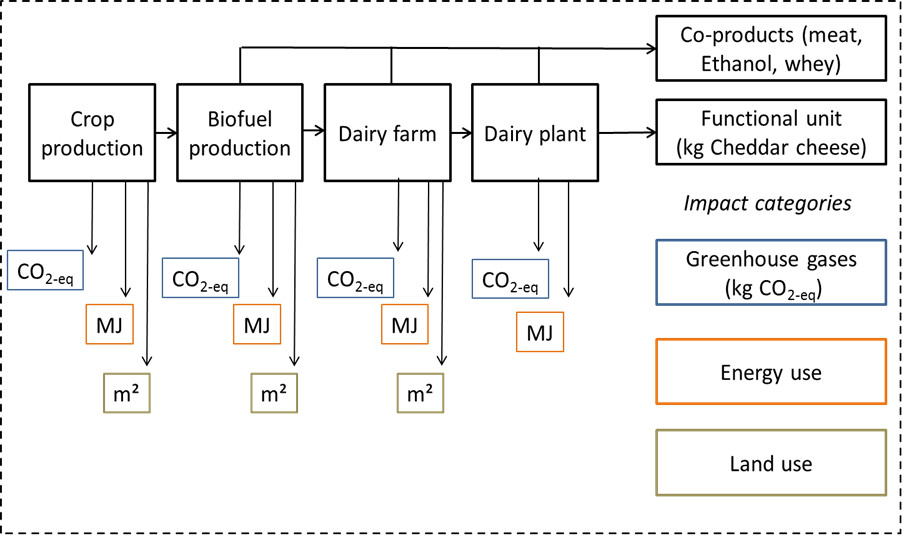
Case in point: about 50 people gathered at the Wisconsin Department of Agriculture to get an update on The Green Cheese Project, which according to its website, is a “a partial LCA of integrated dairy and bio-fuels production systems.”

Yeah, I have no idea what that actually means, so I Googled it and found that for the past couple of years, a group of progressive dairy farmers, state agencies, and faculty at UW-Madison have been working together to quantify energy intensity, greenhouse gas emissions, and the overall environmental impact of dairy and bio-fuel production in Wisconsin. They’re calling their work the Green Cheese Project.

Cool.

And, while I spent most of yesterday’s meeting trying to maintain consciousness and follow acronym-laden lingo, I did glean these facts, which I think are pretty neat:

  • World dairy contributes 4 percent of all man-made greenhouse gases.
  • The carbon footprint of a gallon of milk is 17.6 pounds.
  • The carbon footprint of a pound of cheese is 10 times higher, because it takes 10 pounds of milk to make one pound of cheese.
  • Processing whey, the byproduct of making cheese, has a much larger footprint than just making cheese.

Furthermore, while I have only a vague idea what the above chart represents (there’s a reason I have a Bachelor of Arts, vs a Bachelor of Science), I’m sure someone reading this blog will think it’s awesome. According to Professor Douglas J. Reinemann, it shows the main processes within the life cycle of one kg of Cheddar cheese.

And, while I admit to not understanding nearly as much as I should have from yesterday’s session, it did result in meeting some really cool people who provided more information about the sustainability of dairy. Sarah Gilbert, who works with the American Jersey Cattle Association, gave me a super cool handout on a study done on Jersey cow herd performance, taken from nearly 2 million dairy cows in more than 13,000 herds in 45 states.

The study concluded that per unit of cheese, the Jersey carbon footprint is 20 percent less than Holsteins, as Jersey cows weigh less and produce milk that is more nutrient-dense. Jersey cows also drink only 68 percent as much water as Holsteins, and because they are smaller, emit less methane (cow burps and farts), which unfortunately, contribute to greenhouse gases.

And then there was this study, handed to me by Dennis Presser at DATCP, which reports that computer simulation studies conducted by scientists at the U.S. Department of Agriculture suggest dairy cows raised year-round on pasture provide significantly greater environmental benefits than herds raised in high-production confinement operations.


Hmmm … studying cows on computers, that had to be fun. The study concluded that compared to confinement systems, dairy cows kept outdoors all year had 30 percent lower levels of ammonia emissions, and that a well-managed dairy herd kept outdoors year-round left a carbon footprint that was 6 percent smaller than that of a high-production dairy herd kept in barns. 


In addition, the study found when fields formerly used for feed crops were converted to perennial grasslands for grazing, carbon sequestration levels climbed from zero to as high as 3,400 pounds per acre every year.  Which, is great, providing you live somewhere that doesn’t experience a little something called winter.


All in all, the Green Cheese Project makes me wish I had paid more attention to subjects that ended in “ology” in school so I could understand it better. And if, unlike me, you understood half of what I just wrote about, then follow the team’s Green Cheese Project progress and check back for conclusions and publications coming soon.

The State of American Cheese

The American Cheese Society recently completed the first-ever survey of artisan, farmstead and specialty cheesemakers in the U.S. and Canada, identifying and contacting 851 North American cheesemakers. About a third, 324, participated. While the full report has not yet been released, Christine Hyatt, president of the ACS, published some intriguing numbers from the study in a July story for the Oregon Wine Press.
For example, the study shows in the last 10 years, 61 percent of all American cheesemakers started their operations. Compare this to only 9 percent having started prior to 1980, and you’ll see what all the fuss has been about in American artisan cheese in the last decade.
While I don’t know how many Wisconsin artisan, farmstead and specialty cheesemakers participated in the ACS study, I can tell you that the ACS survey data mirrors what’s happening in Wisconsin. In 2003, when I first started working in the artisan cheese community, we had six farmstead cheesemakers. Today, we have 26 farmstead cheesemakers and a half dozen more farmstead milk bottlers, ice cream makers and yogurt producers. If I were any good at math, I could tell you what percentage growth that was, but as it stands, all I know is that it’s impressive.
According to the ACS data, the ’80s and ’90s were marked by slow growth with an average of just under four new cheesemakers starting up each year between 1981 and 1999. Fast forward to the 2000s, when an average of 19 new cheesemakers started up each year. The ACS reports that the years 2005 and 2010 were tied for the highest number of startups, with 23 each year.
In 2005, I was still working as a spokesperson at the Wisconsin Department of Agriculture. I’ve kept my press releases from those days and went through them just for fun. Here were a few of the headlines I wrote for the state of Wisconsin that year:
  • Grants announced to help Wisconsin processors expand specialty cheese and dairy
  • More Wisconsin dairy producers and processors modernizing, reinvesting in operations
  • New website offers resources for Wisconsin farmstead dairy producers, consumers, buyers
  • Register now to attend farmstead milk and ice cream field day
  • Specialty dairy revolution in Wisconsin: a conversation with Dan Carter
  • WI cheesemakers take center stage at New York’s Artisanal Cheese Center
  • Wisconsin takes top honors at American Cheese Society Competition
Those were heady times — Wisconsin cheesemakers and dairy farmers were modernizing, expanding and launching new products almost every month. I had a hard time keeping up with the news, and because the Dept of Ag obviously wasn’t going to report on every little thing happening in the industry, I started this Cheese Underground blog in 2006, writing anonymously for the first year as a state employee, until some dude named Kevin ratted me out in the Chicago Reader. Shortly thereafter, I left the Dept of Ag and started my own business, working full-time to share the gospel of Wisconsin artisan cheese.
And what a story it’s been. From cows to goats to sheep, American artisanal cheese is coming into its own. According to the ACS study, cow’s milk is still used the most for specialty cheeses, by 64 percent of processors. But goat milk has come a long way – with 50 percent of the study’s respondents using it to make cheese today, a dramatic shift from even 20 years ago, when Fantome Farm’s Anne Topham had to give away goat cheese at the farmer’s market just to get people to try it. Meanwhile, sheep’s milk is used by 15 percent of cheesemakers, the survey results show.
Style-wise, the ACS reports that 77 percent of cheesemakers craft aged cheeses and 63 percent produce fresh product. Ripened and semi-soft are made by about 50 percent, with blue cheese being the most popular offering by 30 percent of cheesemakers. More than half craft cheese with raw milk and 34 percent produce exclusively raw milk cheeses.
Cheesemakers also run very small businesses. Half of all operations responding to the ACS survey have three or fewer employees. Production is also on the low end, with 44 percent of cheesemakers crafting less than 10,000 pounds of cheese a year. The majority sell direct to retailers and restaurants, with 68 percent selling at farmer’s markets, which have also seen a dramatic rise from 2,863 in 2000 to 6,232 markets in 2010.
Christine says ACS staff is working hard to get the full report ready to be released in time for the American Cheese Society’s annual conference in Montreal, coming up August 2 – 6. I’m looking forward to attending the conference, and reporting more about the study from there. 

    Door County Dreamin’ at Schoolhouse Artisan Cheese Shop

    In the summer, California may have, well, California, but in Wisconsin, we have Door County. No bugs, no McDonalds, and no high-rise hotels. Just mom-‘n-pop restaurants with goats on the roof, cute shops and old-fashioned, 24-room motels snuggled into wooded hillsides. And this month, I got to visit this magical little place for the first time.

    So I’m not sure how this happened, but it seems that I’ve been to 36 of the 50 states and six different countries on three continents, but I’ve never been to Door County. I’ve come to the conclusion that’s because they never had a cheese shop for me to visit.

    Until now.

    Entrepreneurs extraordinaire Michael and Janice Thomas opened The Schoolhouse Artisan Cheese Shop in Egg Harbor, Door County (located on the “left-hand thumb” of Wisconsin) on May 25. A cut-to-order store selling ONLY Wisconsin artisan cheeses, the shop is an amazing spotlight for Wisconsin cheesemakers.

    In addition to the usual rock star cheeses such as Pleasant Ridge Reserve and Bleu Mont Bandaged Cheddar, the Thomases have managed to talk several up-and-comers into selling cheese nearly exclusively at their store. An example is Union Star’s St. Jeanne, crafted by young Jon Metzig, who named the cheese after his grandmother, and fashioned it after an Irish cheese that he studied two years ago on a 6-week cheesemaking trek across Europe that became the “So You Want to be a Cheesemaker” blog.

    The Schoolhouse Artisan Cheese Shop also makes to order and sells a handful of artisan sandwiches on fresh, crusty bread (I’d highly recommend the sandwich pictured here, the “Wisconsin’s Best” – Nueske’s applewood smoked ham, Emmi Roth Grand Cru Gruyere, mayo, fig and citrus chutney and crisp romaine) and is one of the only retail outlets that I know of selling Kelley Country Creamery ice cream.

    With eight employees, including shop manager Kathy McCarthy (the daughter and granddaughter of Wisconsin cheesemakers), Schoolhouse Artisan Cheese Shop is the latest brainchild of an energetic couple who have called Door County home since 2004, when they opened the Savory Spoon Cooking School in their renovated, 1847 farm house that was once the historic Olson Dairy.

    The couple ran the cooking school out of their home (pictured at left) the first two years as an experiment to see if people would be willing to pay to learn how to cook. “We figured if it worked, we’d outgrow the space. If not, we’d end up with the coolest kitchen in Door County,” says Michael. The school hit a home run, and two years later, moved into Ellison Bay’s renovated school house/old post office, where it’s been ever since.

    Every June through October, Janice opens up the The Savory Spoon Cooking School – a member of the International Association of Culinary Professionals – for nightly classes on Thursday, Friday and Saturday. However, on select Tuesdays throughout the summer, the pair host a series of “Artisan Cheese Tastings” where a Wisconsin cheesemaker is a guest of honor. On July 12, Andy Hatch from Uplands Cheese will lead a class, with Sid Cook of Carr Valley following on July 19.

    Other cheesemakers, including Katie Hedrich of LaClare Farm; Felix Thalhammer, Capri Cheesery; Chris Roelli, Roelli Cheese; Marieke Penterman, Holland’s Family Cheese; Diana Murphy, Dreamfar; Bob Wills, Cedar Grove Cheese; Bruce Workman, Edelweiss Creamery; and Affineur Jenifer Brozak will round out the summer schedule — for a complete listing of all classes, click here.

    Both the cooking school and the artisan cheese shop provide a unique exposure opportunity for Wisconsin artisan cheeses, as most attendees and shoppers are visitors from Chicago and the Twin Cities. “People discover amazing Wisconsin artisan cheeses here, and then remember them and seek them out when they get home,” Michael says (pictured above). “We have a unique opportunity to spotlight Wisconsin cheese to a growing market.”

    Thanks to Michael and Janice Thomas, Wisconsin artisan cheeses will continue to reach an ever-growing audience. I can’t wait to see what they dream up next.

    Photo credits to Uriah Carpenter.

    Cheddar Brain Trust Gathers at Roelli Cheese

    Above: Vat Captain John Jaeggi, far left, of the Center for Dairy Research talks with  Wisconsin cheesemakers, from left to right: Jerry Hook, Hook’s Cheese; Andy Hatch, Uplands Cheese; Kerry Henning, Henning’s Cheese; and Gary Grossen, Babcock Cheese. More than 20 Wisconsin cheesemakers gathered at Roelli Cheese on June 21 for the first-ever Cheddar Round Table, an educational cheesemaking and networking day.

    So if I were still a journalist and had to write the lead for a news article about my day yesterday, it would go something like this:

    “A group of Wisconsin cheesemakers boasting a total of more than 350 years of experience gathered at Roelli Cheese in Shullsburg yesterday to compare techniques and further their education of starter cultures in the art of cheddar cheese making.”

    However, Master Cheesemaker Bob Wills, who attended the first-ever “U.S. Cheddar Round Table” – the awesome brainchild of Cheesemaker Chris Roelli and John Jaeggi at the Center for Dairy Research – no doubt summed it up WAY better in this comment he left on my Wisconsin Cheese Originals Facebook page:

    “This was a great event. A bevy of cheese dweebs plying their craft and learning about culture. A well placed tornado would have obliterated our industry. We may need to have designated non-attendees in the future.”

    Ha! Yes, despite the threat of severe weather that was supposed to include tornadoes, hail and flash-flood-inducing thunderstorms, the sun shone down on Roelli Cheese yesterday, staying sunny and 85 – or if you were in the cheese plant, a balmy 105 plus 100 percent humidity. I mention this, because while cheesemakers are used to working in a sauna for a living (it’s why they always look so young), I instead spent the day sweating profusely and listening intently to conversations revolving around alien words such as “Lactococcus lactis” and  “Lactobacillus brevis”.

    And while I, a less-than-novice cheesemaker could not always keep up with the conversation (I nodded and smiled a lot), I didn’t have to be a cheese genius to see that the cheesemakers in attendance were having the time of their life.

    While John Jaeggi and Chris Roelli served as “vat captains” for two different vats of cheddar cheese, 20 different cheesemakers from a dozen different companies – ranging from some of the smallest plants to some of the biggest companies in the country – stood alongside, taking turns stirring, cutting, draining, and milling curd. In between, they talked about everything from what starter cultures and rennet they used, to comparing notes on make techniques and aging styles. Mixed in with the crowd were a few distributors, culture house experts, and cheese retailers including Gordon Edgar, of Rainbow Cheese Cooperative in San Francisco and Ken Montelone of Fromagination in Madison.

    “This is a way to talk about what we’re all doing and continue to elevate our industry,” John Jaeggi told the group as they waited for the starter cultures to start their magic. Chris Roelli added that while cheesemakers should not feel obligated to “give away their secrets,” the day was an opportune time to share information for the betterment of all. “Today, my house is your house,” he said.

    After about five hours of morning cheesemaking and networking, the group took a break to head upstairs to the cheese plant living quarters, where Chef Sara Hill prepared an amazing lunch of ribeye steak sandwiches, 4-cheese mac ‘n cheese, asparagus and green beans with Dunbarton Blue, and an awesome caprese salad. Then, an afternoon session of workshops started, with industry experts giving educational talks on starter cultures, cheesemaking techniques, and the latest updates on food safety mandates.

    Perhaps aided by a cooler full of New Glarus Spotted Cow on ice, cheesemakers openly shared information and ideas all day, with many making mental notes of what worked and what didn’t. The afternoon session ended with a full-blown cheese tasting, as almost all of the makers brought along cheese to share. By the end of the day, the group was already planning the next session to be held at a different cheese factory next year. Can’t wait!

    Above: a group of 25 cheesemakers, retailers, distributors and industry experts gathered at Roelli Cheese June 21 for what  many hope to be the first of a series of annual travelling educational cheesemaking days in Wisconsin.

    Goodbye Yellow Brick Road

    If you read this blog regularly, you know I’m Jeanne Carpenter: self-proclaimed cheese geek, grown-up farm girl, accredited journalist and recovering state government propaganda specialist. You may also know that since 2004, in one way or another, I’ve been involved with the Dairy Business Innovation Center (DBIC), a not-for-profit organization that helps new artisan and specialty cheesemakers get started, helps existing commodity dairy plants transition to more specialty (and profitable) dairy products, and assists Wisconsin dairy farmers build and launch new specialty dairy products on their farms, helping them weather the up-and-down cycles of federal milk prices.

    For about the past five years, I’ve served as the communications director for the DBIC, and it’s been an absolute blast sharing the successes of our clients during that time (and often giving the readers of this blog the inside track to what’s new). From dairy plant grand openings, to product launches, to articles on record-breaking specialty cheese production and a stack of ever-growing awards for Wisconsin cheesemakers, there has never been shortage of good news since the DBIC launched an array of technical services to dairy entrepreneurs.

    Sharing good news was always the best part of my job with the DBIC. But, I’ve also come to realize that sharing the not-so-good news is also part of my responsibility to the industry. And unfortunately, this is one of those not-so-good news moments.

    Since 2004, the Dairy Business Innovation Center has received funding for its services through federal funding earmarks (yours and my tax dollars at work), designated through the Honorable Herb Kohl. Senator Kohl has been a tireless champion of Wisconsin dairy, and at the DBIC, we have tried our best to fulfill the mission he gave us seven years ago “to reinvigorate America’s Dairyland.” More than 150 clients later, 68 new specialty dairy products, and more than 50 expanded and newly constructed dairy plants, we like to think we’ve made significant process in accomplishing that mission. And while there is still more work to do, our time at the DBIC is coming to a close, as our original funding resources have ended, and attempts to secure alternative funding are failing.

    As a result, the DBIC Board of Directors recently voted to stretch out remaining DBIC dollars and keep our virtual doors open, with limited services, until June 2012. For the next year, the DBIC will focus solely on providing technical assistance to new specialty dairy start-ups and those dairy plants who are transitioning from commodity to more profitable specialty and value-added products. We will be reducing or ending our training, education, workshops and all non-technical services. Our first and foremost aim is to help as many entrepreneurs and budding cheesemakers start-up or expand their operations in the next year, with a second goal of providing the technical tools to keep them successful in the future.

    While the DBIC may only have one year remaining to continue its mission “to reinvigorate America’s Dairyland,” the legacy of the organization and its founder Dan Carter, an incredible advocate for Wisconsin cheese for the past 50 years, will not be forgotten. I am incredibly proud and honored to have served on the DBIC team from its very beginning, when we had no name and no funding, to the very end, when our name will endure, but our mission will end. I know every consultant who has worked for the DBIC carries in his or her heart the passion to help Wisconsin dairy entrepreneurs, and many of us will personally continue that mission.

    In my role at the DBIC, and of course through my own writing work and event planning with Wisconsin Cheese Originals, I look forward to continuing to tell the story of Wisconsin dairy. I truly believe the DBIC has acted as a yellow brick road to the land of successful value-added dairy for many a Wisconsin dairy entrepreneur, and I am heartbroken it is coming to a close. Please know that Dan Carter is continuing to seek alternative sources of funding to keep the DBIC’s doors open and welcomes input and ideas from the industry in moving forward. Dan may be reached at mrdanieljcarter@aol.com or call 920-387-5085.

    On Wisconsin.